
THE MOVEMENT JOURNAL
DRY NEEDLING · FOURWAYS

You leave a dry-needling appointment and notice an ache later that day. Is it a normal response? Should you stretch, rest or contact the practice? Those are reasonable questions, especially if this was your first experience of the treatment.
Some local soreness can occur after dry needling. What matters is the type of symptom, how it changes and whether it matches the aftercare advice you received. A new or escalating problem should not be brushed aside simply because a needle was used.
This guide helps you describe your response and choose the right next conversation. It does not replace the instructions given by the clinician who assessed you, and it cannot tell you remotely why a particular area is painful.
THE KEY POINT
Local soreness can happen after dry needling. Follow your individual aftercare advice, report symptoms that are worsening or unexpected, and seek emergency care for chest pain or breathing difficulty after treatment.
What soreness can feel like
The Cleveland Clinic overview of dry needling lists soreness during and after treatment as a common side effect. Local tenderness, stiffness and bruising may occur. Its patient information describes increased muscle soreness lasting around 24–36 hours in some people, with bruising sometimes lasting longer.
That is background information, not a countdown that proves every symptom is harmless. You should not wait for a particular number of hours before asking about a concerning change. Equally, comparing yourself with a friend who felt no soreness is unlikely to explain your own response.
Notice whether the feeling is limited to the treated area or is something different from the original complaint. The words you use need not be medical: aching, sharp, burning, tingling or tender to touch can all help you start a conversation.
Clarify what was actually done
Dry needling uses a fine needle without injecting medication. ChoosePT, the American Physical Therapy Association’s patient resource, describes it as a technique that may form part of a wider plan for pain and movement problems.
It is different from a medication injection, and advice about an injection should not automatically be applied to your appointment. Other procedures also use the word needling. If you are uncertain what treatment you received, ask the provider directly.
Useful questions are: Which area was treated? What response might I notice? What should I avoid, if anything? Who should I contact if my response is different? It is easier to follow aftercare when it relates to the specific treatment rather than a generic internet checklist.
A useful plan for the rest of the day
Start with the instructions you were given. If they are unclear, ask for clarification before adding your own stretching routine, intensive exercise or another treatment. You do not need to make soreness disappear immediately to prove that you are recovering correctly.
For ordinary activity, discuss how much movement is appropriate for the original problem as well as the needled area. An office worker returning to a desk and a runner planning an evening session have different questions. Tell the practice what your day actually involves.
Keep the plan simple enough to remember. Write down any advice about exercise, usual activity and when to get in touch again. If you have several exercises, ask which ones are intended for today and whether the response should change what you do.
Do not begin or stop a medicine because of a blog article. Ask the appropriate clinician or pharmacist about pain relief, particularly if you take regular medicines or have a medical condition. “Over the counter” does not mean suitable for everyone.
What to report instead of “it feels worse”
A clear description helps the practice understand the concern. You can organise it around three questions.
Where is the symptom?
Say whether it is in the treated area, spreads elsewhere or appeared in a new place. Mention any skin changes you have noticed without trying to decide their cause yourself.
How much does it affect you?
A pain score may help, but an everyday example adds context. Perhaps turning your head was comfortable before and now is not, or sitting through a meeting has become more difficult. Explain what has changed rather than repeatedly testing the painful movement.
What is happening over time?
Note when the symptom began and whether it is improving, stable or increasing. Include anything relevant that happened afterwards, such as a strenuous workout. These details support an assessment; they are not an invitation to blame yourself for the response.
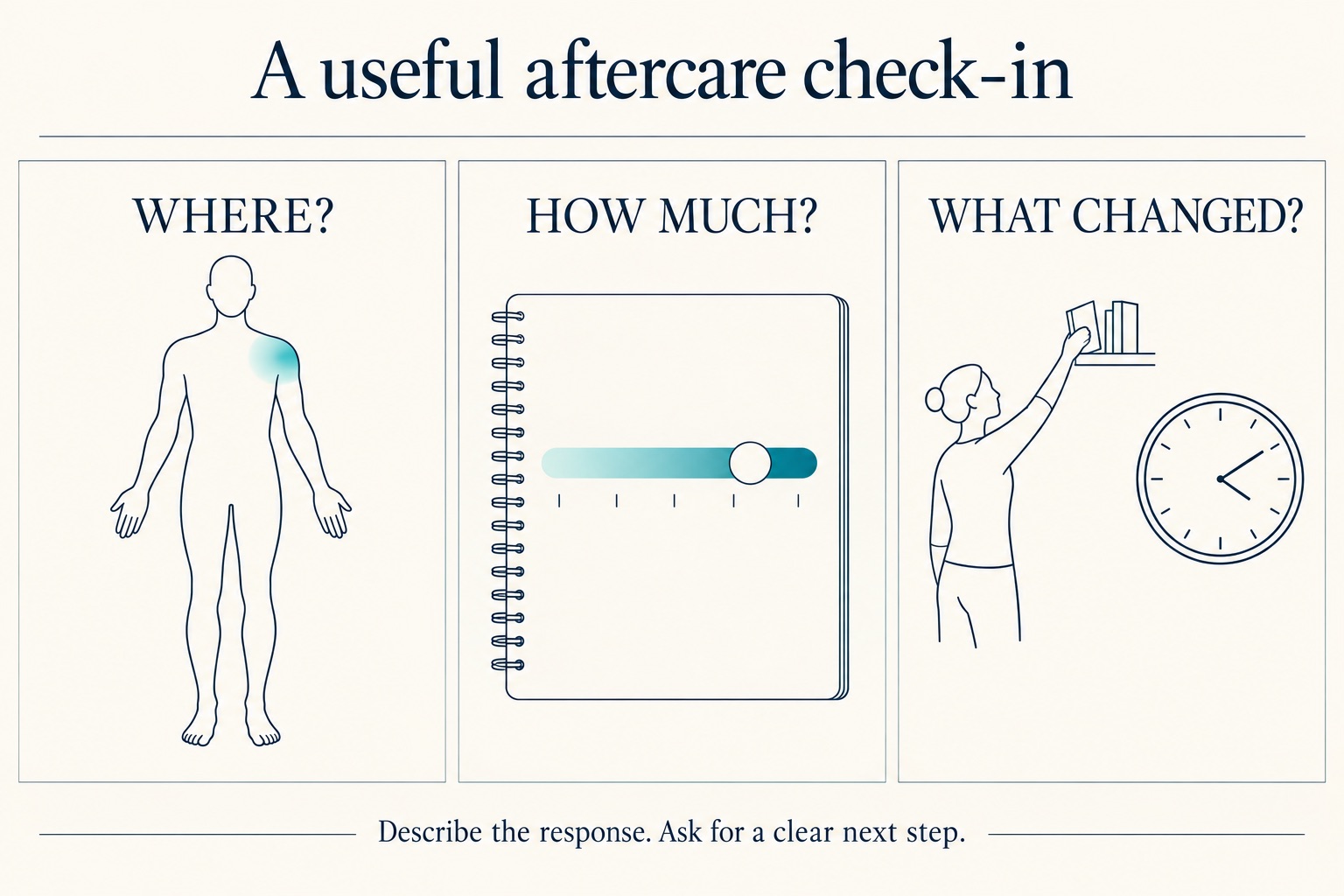
For example: “I had treatment near my shoulder yesterday afternoon. It is now tender around that area, and reaching a shelf feels more uncomfortable than before. It is not easing. What would you advise?” This is an illustrative message, not a patient account. It gives the practice a clearer starting point than asking whether soreness is always normal.
When to seek medical help
Chest pain or breathing difficulty
Seek emergency medical care for new chest pain or shortness of breath following needling, particularly after treatment around the upper back, shoulder or chest region. Tell the medical team that you recently had needling and where it was performed. Do not wait for the practice to reopen or for an email reply.
Cleveland Clinic identifies pneumothorax, or a collapsed lung, as a rare but serious possible complication when needling around the thoracic area. The purpose of this warning is to prompt appropriate assessment, not to suggest that ordinary local soreness means a lung problem.
Hot, painful or increasingly swollen skin
Seek prompt medical advice about skin that becomes painful, hot and swollen, especially if you feel unwell. The NHS information on cellulitis explains these signs of possible skin infection and notes that redness can be less apparent on brown or black skin. A clinician needs to assess the cause; do not diagnose it from a picture online.
Other unexpected or worsening symptoms
Contact the treating clinician promptly about severe or increasing pain, new weakness, persistent altered sensation or bleeding that does not settle. If symptoms are severe or you cannot obtain timely advice, seek medical care. The fact that soreness is possible does not make every post-treatment symptom routine.
What if you have a workout planned?
Ask how the appointment fits with your current exercise plan. A blanket instruction to rest for several days or to train normally cannot account for the reason you were treated, the area involved or your response.
A useful question is: “I was planning to do this session tonight; should I change it, and what response should make me stop?” Include the type of session and how demanding it usually feels. “Gym” could mean a gentle agreed exercise or a heavy workout, so be specific.
If a symptom is worsening or changing your movement, do not use that session to prove you can push through it. Seek advice. The goal is a workable care plan, not a test of tolerance.
Use the follow-up to review benefit as well as soreness
Once immediate concerns have been addressed, return to the original reason for treatment. What were you hoping to do more comfortably? Has that changed? What happens next?
Broadacres Physio lists dry needling, exercise therapy and other treatments. An enquiry can help clarify what is appropriate for your circumstances. No particular technique or number of appointments is guaranteed by this article.
You can also discuss preferences before another session. Ask about alternatives, explain what concerned you and request a clear explanation of the proposed approach. Understanding the plan is part of making an informed decision about it.
Frequently asked questions
Does being sore mean dry needling worked?
Soreness alone does not tell you whether the treatment achieved your goal. Discuss changes in the original symptoms and the activities that matter to you, as well as any unwanted response.
Should I copy somebody else’s aftercare routine?
Use your own clinician’s instructions. The treatment area, underlying problem and health history may differ, even when two people use the same treatment name.
Is it acceptable to contact the practice about mild symptoms?
Yes. If you are uncertain whether your response matches the advice you received, ask. Clear follow-up questions are useful; emergency symptoms still need emergency care.
Can I choose not to have needling again?
You can discuss your preferences and decline a proposed technique. Ask how other suitable options might fit the broader plan for your symptoms and goals.
YOUR NEXT STEP
Book an assessment in Fourways
Tell Broadacres Physio what is bothering you and what you want to get back to. Contact the practice to discuss an appointment and the treatment options appropriate to your needs.
011 467 8300
admin@baphysio.co.za
Broadacres Shopping Centre, corner of Cedar and Valley Road, Fourways.
Add a Comment