THE MOVEMENT JOURNAL
HEAT & COLD THERAPY · FOURWAYS

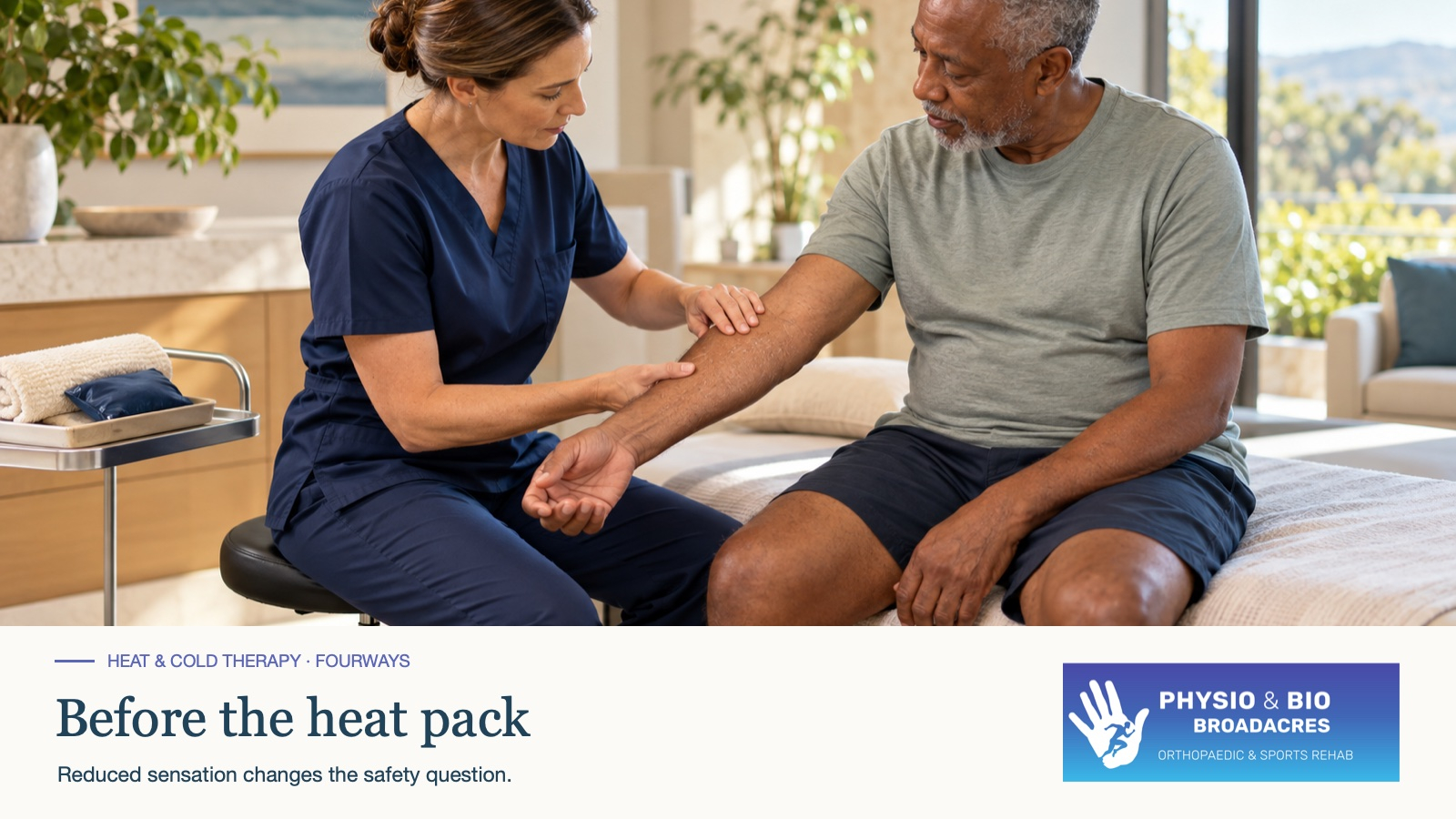
A heat pack can feel like the simplest response to an aching shoulder or a stiff back. But if the skin over the area feels numb, unusually tingly or less sensitive than usual, pause before applying either heat or ice. Reduced sensation changes the safety question: you may not reliably feel when a pack is causing harm.
Do not put a hot or cold pack on an area with reduced sensation while you try to work out what is happening. Ask a healthcare professional about the altered feeling and whether temperature treatment is appropriate. Adding a towel does not remove the need for that advice.
Broadacres Physio offers heat and cold therapy among its physiotherapy treatments. Choosing a suitable treatment starts with understanding the problem, rather than assuming every painful area needs a pack.
The important detail is what you can feel
When discussing a painful area, people naturally focus on the ache. An altered patch of skin can seem like a side issue: perhaps it feels different through clothing, or you notice it while washing. Mention that change even if it does not hurt.
Try to describe the experience in ordinary words. Does the area feel less sensitive to normal touch? Is there tingling? Is the feeling new, spreading or coming and going? You do not need to name a nerve or decide on a diagnosis before asking for help.
Sherwood Forest Hospitals’ heat and ice guidance advises using these treatments only where skin sensation and circulation are normal. It also warns against direct skin contact, use over wounds, and leaving a pack on while asleep. Those precautions matter before choosing between warm and cold.
Do not test numbness with extreme temperatures
Holding something hotter or colder against the area to see whether you can feel it is not a useful home experiment. Nor should you ask someone to keep increasing the temperature until it becomes noticeable. Describe the change and arrange appropriate assessment instead.
If a clinician has already identified reduced sensation, follow their individual advice. A general article cannot override instructions given for your condition or a recent procedure.
A towel is a barrier, not clearance to proceed
Wrapping a pack is a familiar precaution. It can be tempting to believe that a thicker towel makes any application safe. But the cloth does not establish whether the skin, circulation or underlying problem is suitable for temperature treatment.
The Gloucestershire Hospitals guidance on ice and heat recommends protecting the skin and monitoring it, and limits ice use to areas with normal sensation and circulation. A barrier is part of safe use when the treatment is appropriate; it does not answer the earlier suitability question.
This distinction is especially useful when borrowing someone else’s pack. Their instructions may relate to a different product and a different problem. Even if the pack is familiar, your skin may feel different today.
Give the clinician a short, useful history
An assessment conversation is easier when you can explain what changed. A few notes are enough; you do not need a detailed symptom diary before making contact.
- Where is the altered feeling, and when did you first notice it?
- Did it begin after an injury, operation or treatment?
- Is it present all the time, or during particular activities?
- Have you noticed weakness, changes in balance, skin damage or changes in colour?
- Have you already used heat, ice, a topical product or another treatment there?
Mention relevant health conditions and the advice you have previously received. If the numbness followed a procedure, contact the treating team about what is expected and what needs review. Do not assume a symptom is harmless simply because there is a possible explanation.
The NHS overview of peripheral neuropathy explains that altered sensation can occur with nerve problems and recommends medical assessment of relevant early symptoms. This does not mean your numb patch has that diagnosis. It is a reason to investigate a persistent change rather than repeatedly treat around it.

Think about who is applying the pack
At home, the person helping may be a partner, an adult child or a carer. Make sure they know about the altered sensation. “They said it felt fine” is not reassuring if the person cannot feel the area normally.
An illustrative example: an older adult asks a family member for a hot water bottle because their lower leg aches, then mentions that part of the foot has felt numb. The sensible next step is to put the bottle aside and ask for clinical advice, rather than choose a hotter setting or add another blanket. This is a safety example, not a Broadacres Physio patient story.
If you are helping someone who cannot communicate discomfort reliably, ask their healthcare team how any recommended treatment should be supervised. Do not use another person’s previous routine as a substitute for individual instructions.
Check the product as well as the treatment plan
Once a clinician has confirmed that a pack is appropriate, use the instructions for that specific product. A microwaveable wheat bag, electric heating pad, hot water bottle and reusable cold pack are different items. Their heating, cooling, inspection and handling instructions are not interchangeable.
Check the condition of the product and its cover. Do not improvise a higher setting or longer exposure because the sensation seems mild. If the instructions are missing or unreadable, obtain them from the manufacturer before use.
Ask how long to apply it, how to protect and check your skin, how to position it and what should make you stop. The answer should fit your circumstances. A timer is a practical reminder when use has been recommended; it cannot make an unsuitable application safe.
When the change needs more urgent attention
Do not wait for a routine physiotherapy appointment if an injured area becomes numb or develops pins and needles, particularly with a change in shape, unusual colour or cold skin. The NHS sprains and strains guidance identifies these as signs requiring urgent emergency assessment after an injury.
Seek prompt medical advice for new or worsening sensory changes, especially if weakness accompanies them. If you are worried about a skin injury from a pack, stop using it and get medical advice. Applying the opposite temperature is not a substitute for having the skin assessed.
Frequently asked questions
Can I use ice instead if heat is unsuitable?
Not automatically. Reduced skin sensation is a concern with cold treatment too. Ask about the symptom and appropriate options rather than swapping temperatures.
What if only a small patch feels different?
Tell the clinician where it is and avoid applying a pack over it while seeking advice. Size alone does not establish that temperature treatment is suitable.
Does numb skin mean I have nerve damage?
There are different reasons for altered sensation. An online article cannot determine the cause. Describe the change and seek assessment, particularly if it persists, worsens or follows an injury.
Can a physiotherapist help me decide what to do next?
A physiotherapy assessment may help clarify a musculoskeletal concern and whether referral or other advice is needed. Tell the practice about the numbness when enquiring so that the appropriate next step can be discussed. Our first-visit guide explains the assessment process.
YOUR NEXT STEP
Discuss your next step in Fourways
Tell the team about the altered sensation when enquiring. They can discuss whether a physiotherapy assessment or a different next step is appropriate.
011 467 8300 · admin@baphysio.co.za
Broadacres Shopping Centre, corner Cedar & Valley Road, Fourways.
General educational information. Individual assessment and advice may differ. Featured and supporting visuals are generated editorial illustrations with the original practice logo added separately.
Add a Comment